This topic presents a basic approach to develop an electronic machine. The idea is to display the count of votes on a set of seven segment displays. A set of switches are provided through which a user can cast vote. After every cast of vote, the subsequent count can be seen on the seven segments. The segments and switches are controlled through AT89C51. For every candidate, a segment has been provided.
This voting machine is designed for four candidates. The provision of casting vote has been provided by means of four tactile switches. These switches take manual inputs from the user and transfer them to the pins of controller. Based on these inputs, the vote count for different candidates is increased by AT89C51.
To display the vote count, four seven segment displays are also connected to the microcontroller (refer seven segment interfacing with AT89C51). The count value for each candidate is sent to the corresponding segment. The four counts appear continuously by multiplexing these segments through AT89C51.
Pins 2-5 of the port P3 are configured to take inputs through switches connected to them. The data pins of the seven segments are connected to port P2. Pins 0-3, of port P1, are configured as output to act as control/enable pins of the seven segments.
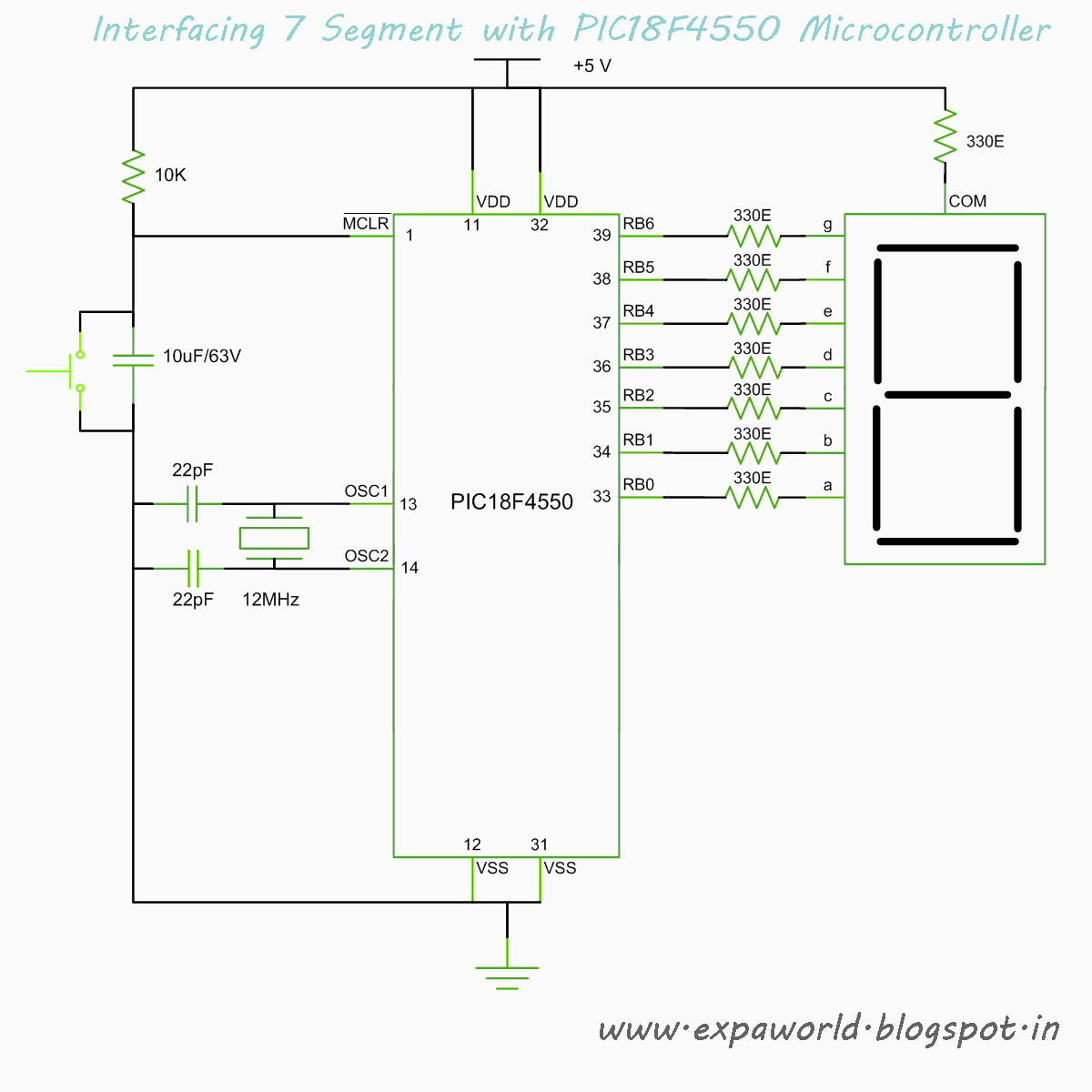
The seven segments are used to display decimal and hexadecimal (0-9, A-F) values. A seven segment is cheapest option for applications requiring numeric value display as output. Calculators, watches, lift’s floor indication panel etc. are examples of such applications. The interfacing and operation of a seven-segment display with PIC18F4550 has been explained here.
It is necessary to understand basic I/O operations of PIC18F4550 before dealing with its complexities. This article presents a way to take simple output from a PIC microcontroller. This learning would also help in interfacing of external devices with the controller. Here the output from the microcontroller is taken on a set of LEDs which are made to blink in an alternate fashion.
Global Positioning System is based on satellite navigation technology. A GPS Receiver provides the accurate location of an object in terms of latitude and longitude. Accurate time calculation with respect to GMT can also be done by using GPS. For more information on different data obtained through GPS, refer GPS Receivers. Here a PIC microcontroller has been interfaced with a GPS module to extract its position information (location).
A Stepper Motor is a brushless, synchronous DC motor which divides a full rotation into a number of steps. For detailed information on working, types and stepping modes, refer the article on Stepper Motors. Here the operation of a unipolar Stepper motor with PIC18F4550 microcontroller has been explained.
FEATURES OF 8259:
1. It is programmed to work with either 8085 or 8086 processor.
2. It manage 8-interrupts according to the instructions written into its control registers.
3. In 8086 processor, it supplies the type number of the interrupt and the type number is programmable. In 8085 processor, the interrupt vector address is programmable. The priorities of the interrupts are programmable.
4. The interrupts can be masked or unmasked individually.
5. The 8259s can be cascaded to accept a maximum of 64 interrupts.
The water level Controller is a reliable circuit, it takes over the task of indicating and Controlling the water level in the overhead water tanks. The level of the water is displayed in the LED Bar graph. The Copper probes are used to sense the water level. The probes are inserted into the water tank which is to be monitored. This water-level Controller-cum-alarm circuit is configured around the well-known 8 bit Microprocessor 8085. It continuously monitors the overhead water level and display it and it also switch Off the Motor when the tank fills and it will automatically switch On the Motor when the water level is low. The Microprocessor will also indicate the water level over the LED display. All the input and output functions are done through the Programmable Peripheral Interface IC 8255.