Motion control plays a vital role in industrial automation. Manufacturing plants in industries like chemical, pharmaceutical, plastic and textile, all require motion control. And it may be a flatbelt application, flow-control application or mixing ofsubstances. Different types of motors—AC, DC, servo or stepper—are used depending upon the application. Of these, DC motors are widely used because controlling a DC motor is somewhat easier than other kinds of motors.
The motion of a DC motor is controlled using a DC drive. DC drive changes the speed and direction of motion of the motor. Some of the DC drives are just a rectifier with a series resistor that converts standard AC supply into DC and gives it to the motor through a switch and a series resistor to change the speed and direction of rotation of the motor. But many of the DC drives have an inbuilt microcontroller that provides programmable facilities, message display on LCD, precise control and also protection for motors. Using the DC drive you can program the motion of the motor, i.e., how it should rotate.
Source: Kitsnspares
The objective of this paper is to provide an automatic railway gate at a level crossing replacing the gates operated by the gatekeeper. It deals with two things. Firstly, it deals with the reduction of time for which the gate is being kept closed. And secondly, to provide safety to the road users by reducing the accidents.
By the presently existing system once the train leaves the station, the stationmaster informs the gatekeeper about the arrival of the train through the telephone. Once the gatekeeper receives the information,he closes the gate depending on the timing at which the train arrives. Hence, if the train is late due to certain reasons,then gate remain closed for a long time causing traffic near the gates.
By employing the automatic railway gate control at the level crossing the arrival of the train is detected by the sensor placed near to the gate. Hence, the time for which it is closed is less compared to the manually operated gates and also reduces the human labour. This type of gates can be employed in an unmanned level crossing where the chances of accidents are higher and reliable operation is required. Since, the operation is automatic, error due to manual operation is prevented.
This topic presents a basic approach to develop an electronic machine. The idea is to display the count of votes on a set of seven segment displays. A set of switches are provided through which a user can cast vote. After every cast of vote, the subsequent count can be seen on the seven segments. The segments and switches are controlled through AT89C51. For every candidate, a segment has been provided.
This voting machine is designed for four candidates. The provision of casting vote has been provided by means of four tactile switches. These switches take manual inputs from the user and transfer them to the pins of controller. Based on these inputs, the vote count for different candidates is increased by AT89C51.
To display the vote count, four seven segment displays are also connected to the microcontroller (refer seven segment interfacing with AT89C51). The count value for each candidate is sent to the corresponding segment. The four counts appear continuously by multiplexing these segments through AT89C51.
Pins 2-5 of the port P3 are configured to take inputs through switches connected to them. The data pins of the seven segments are connected to port P2. Pins 0-3, of port P1, are configured as output to act as control/enable pins of the seven segments.
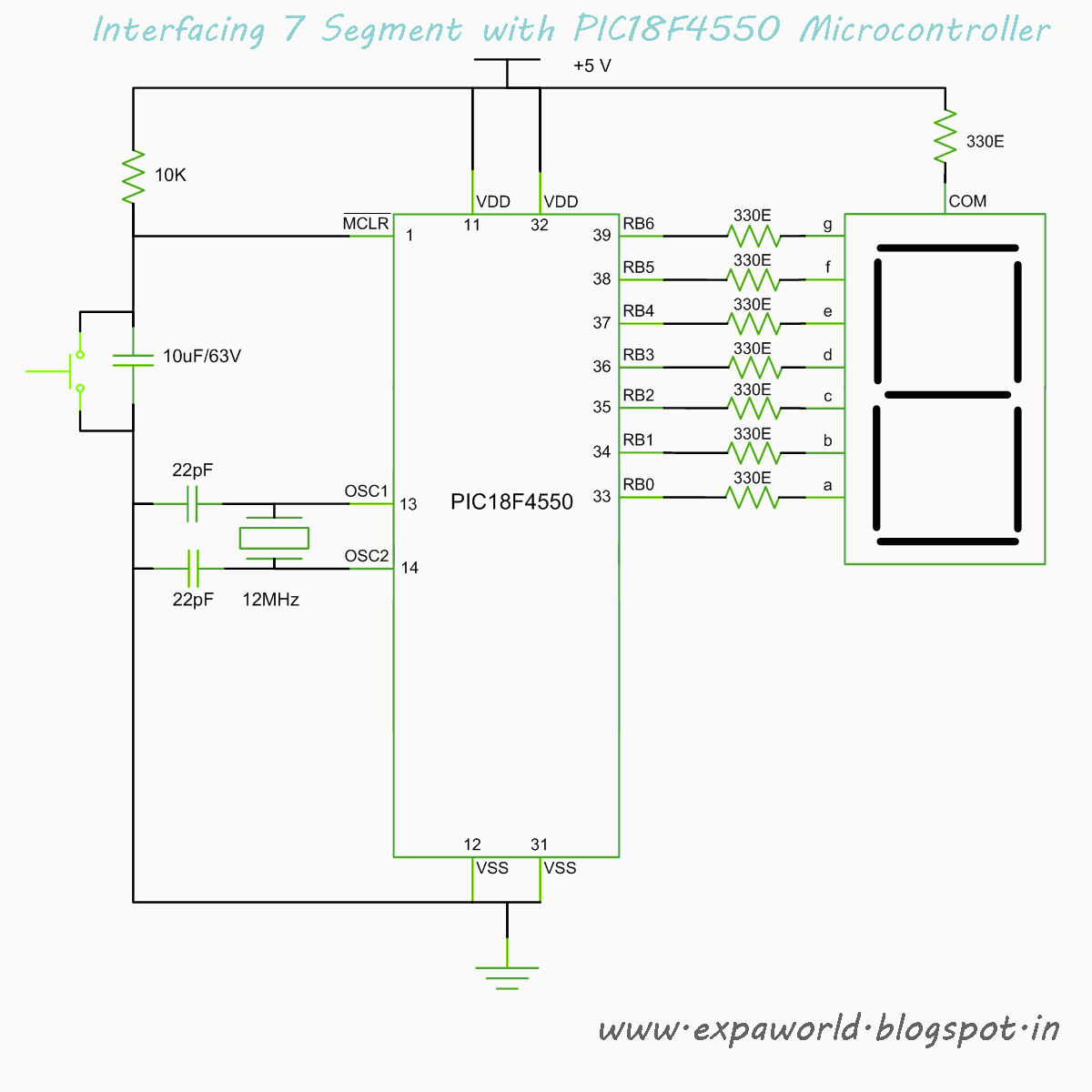
The seven segments are used to display decimal and hexadecimal (0-9, A-F) values. A seven segment is cheapest option for applications requiring numeric value display as output. Calculators, watches, lift’s floor indication panel etc. are examples of such applications. The interfacing and operation of a seven-segment display with PIC18F4550 has been explained here.
It is necessary to understand basic I/O operations of PIC18F4550 before dealing with its complexities. This article presents a way to take simple output from a PIC microcontroller. This learning would also help in interfacing of external devices with the controller. Here the output from the microcontroller is taken on a set of LEDs which are made to blink in an alternate fashion.
Global Positioning System is based on satellite navigation technology. A GPS Receiver provides the accurate location of an object in terms of latitude and longitude. Accurate time calculation with respect to GMT can also be done by using GPS. For more information on different data obtained through GPS, refer GPS Receivers. Here a PIC microcontroller has been interfaced with a GPS module to extract its position information (location).
A Stepper Motor is a brushless, synchronous DC motor which divides a full rotation into a number of steps. For detailed information on working, types and stepping modes, refer the article on Stepper Motors. Here the operation of a unipolar Stepper motor with PIC18F4550 microcontroller has been explained.